Showing posts with label education. Show all posts

Tuesday, June 30, 2015

It Takes a Village


As teachers, it is our responsibility to involve all parents in the education of our students. We normally do this pretty well. However, it has come to my attention that many of the parents of our Spanish-speaking students are less involved in the education of their children than the other populations of students. I will discuss with you the importance of involving all parents, the difficulties you may face when trying to encourage your parents to become more involved, and some ideas known to work when getting parents involved in the education of their children.

Research has shown that parental involvement in education affects the outcome of their children’s academic achievement. Many parents who are less involved in the education of their children are parents of children who achieve at lower academic levels than students whose parents are involved. Therefore, having family members, as well as other members of the community, of the Spanish-speaking students involved can give the student a validation of their own culture and help them understand the importance of their education. Parent involvement further ensures there is an open line of communication between the teacher and the family, which is often key in addressing any difficulty the student may be having as the problem arises. Furthermore, it helps the parent to understand what their children are speaking of when they return to their home. Parental involvement can also be beneficial to you, as the teacher. You can learn from the parent the differences in the Spanish-speaking culture and our own. You can also teach the parents how our culture works and what is expected of their child as a student.

Differences in cultures will be the number one difficulty that a teacher of a Spanish-speaking student will face. You may think that the student’s parents are not interested in their education, which is usually not the case. In some cultures, the parents are not involved in their children’s educations and may expect our education system is the same. Also, there may be a greater value on education for your male English Language Learners (ELL) than your female. Many parents of Spanish-speaking students do not feel as if they belong at the school. They may feel uncomfortable for various reasons. One main reason could be his or her own experience with school. If you have a parent who had negative experiences in school, they will be less involved in their child’s education. Another reason that a parent may not seem involved is because their work schedule does not give them time to come into the school. The parent may work while their student is in school and cannot meet during school hours, or the parent may work more than one job and not be able to meet on your schedule. The parents and families of the students may also view an education as less important than religious activities and other activities such as family businesses, in which your student may work. There may also be language barriers that hinder your ability to communicate with the parents. Remember that even people who seem to speak English well may not be able to understand what you are talking about when speaking to them. A lot of meaning can and usually is lost in translation. Some of the community leaders may be resistant to coming in for many of the before mentioned reasons. Also, they may see education as solely your responsibility in which they should not be involved. These are just a few of the difficulties you may face as a teacher of a Spanish-speaking ELL.

Although it seems there are a lot of difficulties in reaching parents and community leaders in the Spanish-speaking community, there are a lot of ways you can help bring them into the education system so that Spanish-speaking ELLs will benefit. You can validate the student’s culture by inviting their parents and community leaders to come into the classroom. At this time, you can have them tell the class about their culture and share their customs and beliefs with the class. This will also be beneficial to the mainstream students in your classroom by providing a culturally enriched environment for learning. You can ask the parents to cook some of their native foods to share with the class and explain why the food is important to the culture. Other suggestions would be to have any parent/teacher correspondence translated into Spanish by a native Spanish-speaking colleague. This can help the parents understand that you value their language and culture. You can notify the parents of their rights and responsibilities, and let them know about the rules and procedures for your school and classroom. Be upfront with the parents and let them know what is expected of their students. For parents that do not speak any English, make sure you have an interpreter available (not the student) to help you communicate with the parents and use non-verbal messages and cues, such as meeting them at the door and walking them to the door. You can also invite the parents to take a tour of the school, and show them your classroom as well as inviting them to observe your classroom. Another tip is to be available and keep all lines of communication open to the parent. You should meet on the parent’s schedule, not yours. So, you may have to take time out to do home visits. This can give you more insight into the cultural differences between the Spanish-speaking community and your own. It will also give you an opportunity to learn the student’s talents and interests as well as their culture. Encourage the parents or other family members to read to their student, and if they cannot read, have their student read to them. There are many, many more ideas for getting Spanish-speaking family members involved.

Overall, the most important factor is the education of the student. With the  student’s parents and the community’s involvement, the student will be more apt to care about his or her own education; and as a team, you and the student’s parent will be able to provide the student with an environment in which he or her can grow and learn, which will better prepare the student for his or her future.

Saturday, May 31, 2014

Class of 2014

My son, Damien Brown graduated today. Damien is a young man with autism, who was considered low-functioning when he was first diagnosed. Damien was fully special education when he started middle school at Clack. By the time he began Cooper High School, he was in all regular education classes with special ed supports. Damien graduated as a Texas Scholar and with AP credits. Damien is the editor of the Cooper Crest and a member of the Creative Writing Club. Damien plans on going on to college to become a psychologist. Damien has autism, but autism has never had him.


Saturday, September 28, 2013

Erikson’s Theory of Psychosocial Development

I find there are three stages in Erikson’s Theory of Psychosocial Development where faith can play a significant role in social development. During the Identity vs. Role confusion stage, adolescents are trying to find their identity and fit in to society. They hope to do so in a positive manner. They also begin at this stage to start thinking more philosophically and spiritually. Through their ability to become devoted to friends and causes, they may find themselves joining a peer group that has a Christian background. This gives many a feeling of identity. This is also the stage that most adolescents’ faith is being tested. If their peer groups are delinquents, or they have developed an inferiority complex from the previous stage of development, they may find themselves becoming delinquents as well. The next stage that I feel faith may contribute to the emotional and social development of the individual is the Generativity vs. Self-absorption or Stagnation stage. Many individuals in this stage begin to teach their children about their culture, if their culture is a Christian culture, the individual may want to pass their ideals on to their children. They begin to look at the bigger picture. In other words, they no longer see the world as a place that holds them as the epicenter, but now may see the world as much bigger than them. They want social change and to help their brothers. They usually turn to faith to find the answers on how to help. On the other hand, if the person is more self-absorbed, they do not see the world in the same way. They may want to strive to help only themselves. Their end goal may be material, even if they feel that they are faithful, or Christians, they may be more devoted to the capitalist dream than to Christianity. The final stage that I feel faith may play a big part in is the Integrity vs. Despair stage. We all learn at a young age that death is inevitable. Whether you have faith in an afterlife or not often determines whether you fear death or not. A person with a lack of faith may fight death all the way, but those with a strong sense of Christianity, may be more accepting their inevitable fate.

Thursday, March 28, 2013

Another Setback?

I hope that we are not about to experience another setback in Damien's education. At his ARD meeting on Tuesday, we were informed that the way the new law reads Damien must pass the exit level math TAKS test in order to graduate with the recommended diploma that he has worked so hard for. Instead, failure of the test this year will mean that he graduates with a special education diploma, which will prevent him from getting into college.

Here is where I am disappointed. Damien started middle school with a full special education schedule. All of his classes were remedial, resource, classes. His dream to go to college had driven him to leave middle school and begin high school with no remedial classes and a full mainstream, recommended, schedule. He has worked so hard in high school to keep his grades up that he is in an Advanced Placement (AP) English course this year and will be in not only AP English but also AP History next year.

Damien has passed all of his classes including his math classes with fairly high marks (all As and Bs). He has pushed himself very hard, so that his dream of being a college graduate will be realized. However, this test, this one day in time, this snapshot of school will determine whether or not that dream will ever become a reality.

I do not understand the shift in standardized testing. This is not what standardized tests were designed to do. Standardized testing was developed by the Chinese and designed to gauge the teacher's performance in the classroom, not the students. The students' overall performance cannot be gauged by one day in time. Their overal performance can only be gauged in the classroom.

Do students' grades no longer mean a thing? Does all of this hard work and effort that Damien has made account for anything? Can you imagine an AP student graduating with a special education diploma because they did not pass one test? Texas Tech, Damien's dream school, will not even look at an application that has a special education diploma from high school. Damien knew this, and that is why he has worked so very hard.

I need advice on where to go from here. What am I to do to help my son? We cannot allow this to happen, and we cannot just let this go. The Texas Education Agency and U.S. Department of Education are sending the message to this one child and other children that look up to him that hard work accounts for nothing. Just the test does.

Thursday, March 7, 2013

About Locus of Control

Locus of control refers to how a person perceives the cause of life events. Someone with an internal locus of control would generally perceive herself as responsible for certain occurrences (his actions would have a direct bearing on the result), while a person with an external locus of control would most often blame (or thank) fate, destiny, luck, society or some other force beyond her control.

Different people credit different forces for such life events as personal successes and failures. For example, if a struggling actor does audition after audition only to be rejected time and time again, he might blame his own lack of ability ("I'm a terrible actor" or "Nobody likes my acting"). In this case, his locus of control for his failures would be internal. But if one day, this same actor were actually offered an acting job, he might place this success on circumstances beyond his control. He might not believe that his own performance, talent, hard work, or exceptional efforts got him the job, but would rather make rationalizations against his own effort ("I was probably the only audition" or "Gosh, that was a stroke of luck"). When it comes to success, he believes that he has no say in what happens-he is merely a helpless participant in a fate determined by random circumstances. Evidently, one can have a different locus of control for personal successes than for personal failures.

There is a certain tried and true recipe for coping with the challenges and stresses of life. In fact, research has shown that in academics, athletics, and other competitive fields, a particular locus of control is most likely to encourage success. In terms of success, it is best to attribute it to stable internal forces. For example, a public speaker who concludes his first speech to uproarious applause would do best to thank his own orating abilities, writing skills, and sense of humor. He would also benefit by believing that he could do it again if he had to.

When it comes to failures, however, it is wisest to adopt another strategy. Those who are best off feel that they fell on their face (figuratively speaking) due to unstable and even external forces. For example, it is healthiest for an athlete to blame a slight headache or tension (both are unstable internal forces), poor weather conditions, or bad shoes (both are unstable external forces) for coming up short of the mark. By doing so, the athlete is maintaining a fundamental confidence in her own abilities, since presumably the headache will go away, she can relax, or wear different shoes, and the conditions will be better next time. With a basic faith in her capability, she will feel motivated to try again. In short, it is important to internalize success, but NOT failure.

However, there are limitations. While it is best to thank your own talent and abilities for success and to blame failure on something out of your control, it is also important to remain firmly grounded. It is of no benefit to miss out on learning from your mistakes because you consistently blame society for your failures. Nor is it useful to be totally blind to your own limitations (we all have them) or lack of effort. There are obvious advantages to realizing where YOU might have come up short in an instance of failure. Then you can go about fixing the problem in order to heighten the probability of success the next time. To find this balance, one needs a healthy sense of self and a reasonable grasp on reality.

Friday, March 1, 2013

Bully Teacher


I am so angry with the school because a teacher has been exiling Damien from the classroom WITHOUT a pass due to another student saying, “He makes me uncomfortable.” His IEP specifically states that if he gets stressed, the teachers are supposed to either make concessions for him as providing him a place to pace or if the students complain, send him to content mastery, so he can pace there.

Instead, she sends him out of the classroom without a pass leaving him vulnerable to getting detention for being out of the classroom without a pass. She violated the IEP, therefore, she broke the law. I feel this would have been the perfect opportunity to have Damien teach the students in the class about autism.

Instead, she backed up the thoughts that there is something wrong with children with autism, and they are something to be scared of. I feel that the repercussions of the media’s Sandy Hook lashout toward people with autism has finally reared its ugly head. I was expecting to see it soon, but I did not think it would be from a bully teacher.

Damien begged me not to call the school and refused to tell me which teacher it was. I respected his wishes and did not call for a couple of days, but the more I thought about it, the more I decided that they are just bullying Damien for being himself, no other reason. I never believed a teacher would back up a bully.

We have worked far too hard to have Damien accepted by his peers. He has taken himself from being considered low functioning to now being considered high functioning. He has advocated for himself time and time again, but because he likes this teacher, he is afraid to say anything. Now, this teacher has undone 15 1/2 years of work. I will not stand for it.

That other student will continue to marginalize, bully, and be frightened of children with autism. I will not stand for that.  It is a disservice to both Damien and this other child to treat Damien as something to be afraid of.

I called the special education counselor, and she assured me that this will be remedied as soon as possible. It better be.

Wednesday, January 30, 2013

Reflection on TEACCH Workshop

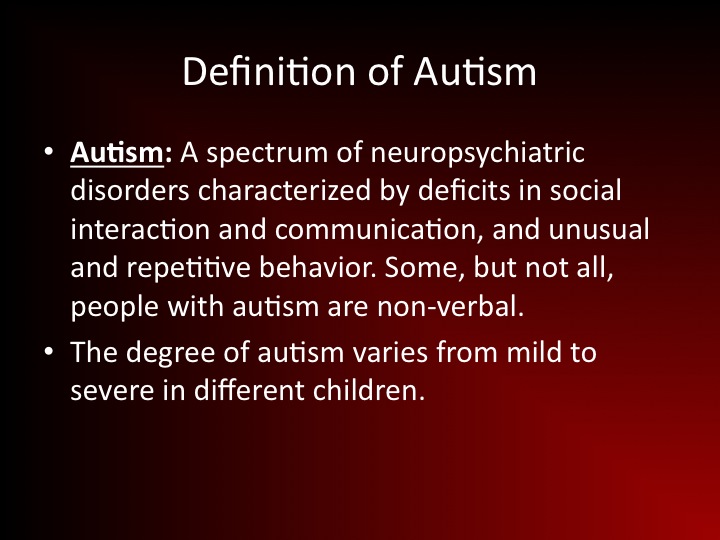
I feel the TEACCH workshop was beneficial to my future goal of becoming a special educator because it provided me with vital information about Autism Spectrum Disorders (ASD) and provided me with ideas on how to teach students with ASDs. It is no secret that the number of students with an ASD is on the rise. In 1996, studies showed that 1 in 160 children were diagnosed with an ASD. Not even a year ago, the number was 1 in 150; and today, a new study shows that the number is now 1 in 90 children are diagnosed. What this means to the education community is that all teachers must adapt their curriculum to include methods of reaching students with ASDs.

The TEACCH workshop provided me with concrete methods of teaching students on the autism spectrum. Gary Mesibov showed us how to use manipulatives and what types of manipulatives can be used. He showed us how to teach our students with ASDs to become more organized so they will be better prepared for their futures. The use of colors, lists, and schedules were stressed for this purpose. Mesibov taught us the importance of teaching new skills or skills to be mastered in context so the students with ASDs can generalize their skills from one setting to the other. He showed us how using real world situations to teach these students can be beneficial to their learning. Mesibov also talked to us about teaching social skills to students with ASDs.

What I enjoyed about the workshop is that all of the methods we were taught can be used to teach mainstream students as well. He provided me another method of differentiating instruction so that I may reach the educational needs for all of my students, not just my students with autism. I feel that all teachers should receive similar autism training because of the rise in the population of students diagnosed with ASDs. In order to provide my students with ASDs with an appropriate education, I do plan to use many, if not all, of the methods Mesibov has provided us with.